Energy, inspiration, emotion, talent, experience. Creating powerful design concepts takes everything we’ve got. You would think that clients would run to reward such a rare combination of hard work, momentary enlightenment and painfully acquired know-how. You would think. Instead, this is how it usually goes:
- Client calls creative with urgent need
- Creative invests it all in satisfying said need
- Client has no urgency to pay
Many of us are being treated as firefighters. We must come through with consistently impressive design concepts in exchange for completely uncertain pay. When clients approach us to solve their most pressing creative problems things run amazingly smoothly. They are eager to commit, negotiate a rate, agree on deadlines (now those are important to them), and get started ASAP (which is yesterday, of course). Once the fire goes away, however, everything seems to run more slowly. So, how exactly do we speed up the payment process, show our true value, and ensure that our creativity doesn’t starve?
Collecting payment will never be easy, but with the right tactics it can become bearable and even fulfilling. Here’s what you do to increase your chances of getting paid fairly and on time:
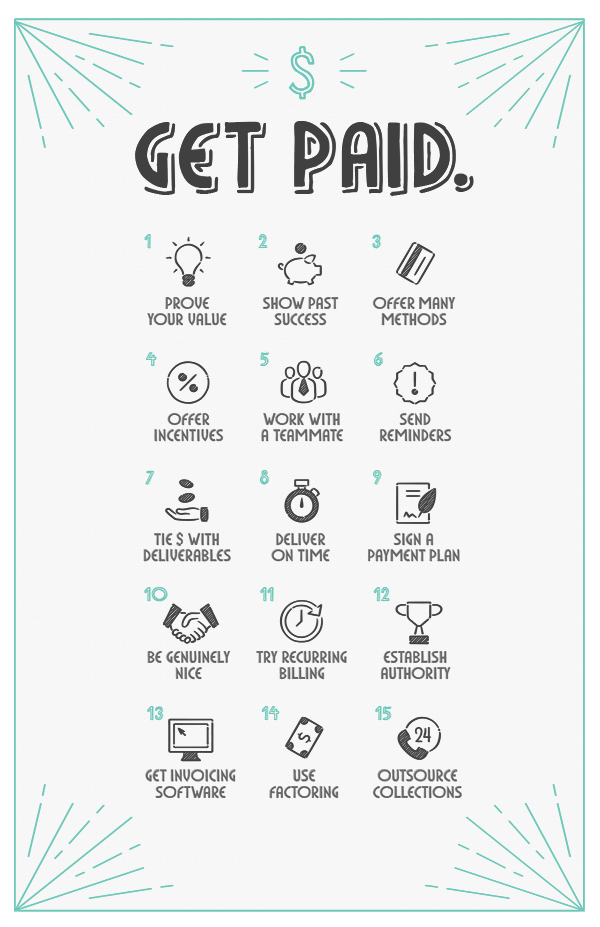
Print out a poster version of these tips.
1. Prove your value in economic terms.
Will your work boost brand recognition? What does that do for sales and revenue? How does that impact market share (broadly)? Arm yourself with research that proves the business value of design, and make sure that you communicate it to your client succinctly. Your business proposal is an ideal place to include these facts.
2. Show that you’ve been paid before.
Social proof can decrease the amount of risk that clients feel when they are about to pay for your services. Hey, if others have bet on your talent in the past, why would they miss out on it? In showing that your clients consistently pay for work, and do so on time, you will give a clear picture of what your expectations look like. I saw clients delay my agency’s payment while being completely on time with other types of suppliers, and had always wondered what they were doing right (or what we were doing wrong). Here’s what that was: other suppliers established that on-time payment was the minimum standard to carry on any type of relationship with them, and that this rule applied to absolutely everyone.
3. Offer more than one payment method.
Cash is not necessarily king when clients need convenience. Explore online payment tools that allow you to expand your clients’ payment options. Stripe offers credit and debit card payments, while Paypal allows for additional methods like real-time and delayed bank transfers. For in-office payments try Square.
4. Provide several payment schedules.
Don’t wait until they ask or default. Structure a tiered payment policy where those who pay first pay less (Early Payment Discount). Also show how a late payment can make them incur in unwanted penalties. While some designers cringe at the sound of “late fee”, including it up front does insulate you (and your team) from a budget-crushing delay. There’s no reason for a late fee to feel like a threat. It is the very least you can do to pass on the message that your waiting time is worth some real money (versus, you know, hot air). And don’t be fooled: a dollar today is worth much more than a dollar tomorrow. For every minute that your hard-earned cash spends in someone else’s wallet, there are several profitable investments that you could be engaging in instead.
5. Work with a teammate.
Listening to several voices asking for the same thing can increase the sense of shame for nonpayment. Ask someone from your team, or hire a third party, to contact the client on behalf of your company. While risky, hiring out a freelancer to make these types of calls might be a low-cost alternative. To hire a professional collections agency, check out point 15.
6. Send out automated email or SMS reminders.
As much as I struggled with this idea, not all clients are purposely trying to skip your payment. Sometimes memory fails and there are no systems in place for reminding themselves of upcoming dues. In this case, make sure that you do prepare to warn them about dates and fees. While a personalized email or call might seem the best way to go about it, these take valuable time away from the actual work that you are supposed to be doing for the client. After all, he/she hired you because of your design talent, not your ability to collect payment over the phone. Setup automated reminders with software packages like Quickbooks, Zoho Invoice, Xero or Freshbooks.
7. Tie key deliverables to payment.
Though this is a double-sided sword (i.e. you will miss payment whenever you miss a deadline), it’s a good business practice and will generally benefit the creator. Sometimes we ask for an advance upfront and a final payment after we’ve delivered everything the client has required. A smarter way to approach this is to condition key deliverables to paying different (smaller) percentages of the total bill. A key deliverable is something that is highly valuable in the eyes of the client: a finalized site launch, logo concept, or business card design are all good examples. If the client really wants to get a hold of his/her company’s new logo, attach a specific percentage of the total bill to that delivery. 30% upfront, 30% upon logo delivery and 40% at the end of all remaining work is an example of such types of agreements.
8. Deliver on time.
In the end, every design project is a transaction. You exchange currency (i.e. amazing work) for dollars. Make sure that you are holding up your end of that deal, and clients will feel the need to be reciprocal. To reinforce the idea that you are complying to what was signed, use wording like “as promised” or “as we agreed” in emails & other types of communications. These subtle pointers signal commitment, trust and reliability. Now, if we’re being super reliable, how could anyone want to disappoint us? (They don’t want to, but end up doing it anyway. Read on for more tactics).
9. Have them sign up to a payment plan with specific installments.
Some contracts include a specific space for signatures on the project payment plan. The advantage of having clients agree to this specific plan in advance is that they are committing to honoring your fees properly at the time when they need your services the most. With time, their initial urgency fades and can result in the firefighter effect that I discussed before. Hi! Excited to work with me? So am I. Now let’s agree on a payment promise while we’re both happy

10. Be genuinely nice.
When I first founded an agency in 2008, we gave out seasonal corporate gifts that reminded clients of how important our relationship was to us. I soon realized that we were not alone. This Corporate Gifting Survey, conducted by the Advertising Specialty Institute, concludes that businesses spend approximately on a single client’s gift. Top goals include showing appreciation, developing relationships and generating goodwill. Think about it: if corporate gifts weren’t effective business tools they wouldn’t be a billion market (in the US only). And reciprocity, my friends, can be a powerful thing.
11. Try recurring billing.
Is your client paying for a product or service on a monthly basis? Perhaps you have set up a continuous design service package, or you sell web design as a service (yes, this is a thing). In this case, you can set up a monthly billing plan with platforms like Paypal or Stripe. Your client’s card will automatically be charged each month, removing the stress associated with collecting your fees.
12. Establish authority in your communications pieces.
Think about how you can position yourself (or your team) as an expert in brand stationery, websites, proposals, contracts and other pieces. Do you belong to a professional organization? Has your business been certified by a partner? Has the agency won any awards? These are things that your client needs to know. In an environment of respect and admiration, it becomes harder to elude responsibilities.
13. Find and use robust timesheet/invoicing software.
Oh, let’s face it. Sometimes we’re not getting paid because we forgot to send that invoice. Whatever comes next is on us. To avoid delays that arise from our end of things, make sure to try an agile invoicing platform. If your fees are based on an hourly rate, there are amazing tools that will also help you keep track of the amount of work invested and calculate your bill automatically. For painless time tracking and invoicing, try Harvest, Ballpark, Ding, Toggl, Timely or Everhour.
14. Use factoring.
Factoring is a simple procedure where your outstanding invoices become cash in exchange for a specific fee. There are many banks and financial companies that will literally buy your accounts receivable (everything your clients still owe you) and turn it into cash. Their commission can go anywhere from 15 to 30% of your invoices, but conditions may vary depending on your annual revenue and other factors. For freelancer-friendly invoice advance options, try Fundbox and Bluevine.
15. Everything else failed? Outsource collections.
OK, we’ve reached that point. This negligent jerk simply won’t pay and nobody’s got time for that anymore. Outsource the struggle. For effective debt recovery services, try TrueAccord or InvoiceCare.
Is there anything worse than begging for something that’s yours? As creators, we invest our very best to solve our client’s problems, and should expect a minimum level of appreciation from them. This appreciation comes in various forms, but only one can literally feed us: payment. At the very least, we should expect them to hold up to their end of the deal and pay the right fees on the right dates. Try these tactics and let us know if they work out for you. (Oh, and feel free to print out a poster version of these tips!)

Know any other secrets to get paid on time? By all means share!
Products Seen In This Post:


Charge Your Worth: The Complete Guide to Getting Paid


