Showing posts with label Want. Show all posts

Friday, April 10, 2015

8 Things You Don’t Want In a Startup Partner

Everyone you know is starting their own business – people from any age group: teenagers, adults in their 20s, 30s, 60s. And most people realize that going at it alone is a hard feat. This is when one brings up the issue of bringing in a partner, whether it’s to double the starting capital or to bring in a necessary set of skills you don’t have. And it’s a good plan actually.


IMAGE: Edyta Pawlowska

Many successful businesses start off as partnerships, like Google’s Sergey Brin and Larry Page, Facebook’s founder Mark Zuckerberg and his four other co-founders. The founders have someone to share the trials and tribulations of opening a startup with, and it also helps with easing stress levels.


Then again, there are some traits that you do not want to have in a startup partner and for some of us, these warning bells do not ring as early as it should. Instead of studying what traits company founders look for in their partners let’s look at what traits there are that we should distance ourselves from instead.


1. You don’t want a partner who is all talk, but has no proven track record.


There are three types of people in the world: those who are good at talking and doing, those who are terrible at talking but are great at doing, and those who are great at talking but are terrible in doing things. I have met all three, and among them the most dangerous is the last one.


They will make you believe that everything is going to be alright, that everything is under control, and if you are unlucky enough to fall for their sweet talk, you will soon find yourself wondering who was the real fool.


When interviewing for a partner, be sure to ask for their resume or CV and have them explain what they did in their previous work, projects, and other ventures. It also wouldn’t hurt to verify the things they say.


IMAGE: Sergio Garau

In the current state of the internet, most things are already online. A red flag for a potential partner is that when you do a quick search for their name and little to nothing comes up in the results. If your prospect partner has been successful in one industry or another, there should be some digital trails of his adventures on tweets, Linkedin and Facebook posts, blog posts, news clippings, even a personal website, or a mention in a press release.


Just think about it. Just about anyone can start a website anytime and slap their face there under a different name then claim that he or she had been a web designer for 30 years. Seek out their credibility and make them authenticate their authority.


2. You don’t want a partner who is inconsistent.


Startups are always on the line. No time or resources can afford to be wasted. If your partner decides on doing one thing today, and another the next day, you should be worried. It’s okay if you have enough resources to "waste", sometimes it is inevitable, particularly if you are aiming for innovation. But while you’re still in the process of figuring things out, you need to be laser focused.


That’s also probably the reason why you are looking for a partner, so that two people can focus on two important and bigger things.


You can easily spot an inconsistent person by looking at their resume. Have they handled a couple of jobs in the span of a year? Have they jumped from one project to another? It would also be prudent to ask for character references that you can contact and talk to. Think of it as a feedback gathering exercise. If your would-be partner is consistent, things will check out.


3. You don’t want a partner who is bad At dealing with people.


It’s a big world out there and there are plenty of people who have no idea what is culturally acceptable and what is not when dealing with other people. For example, a friend of mine told me how their company’s new partner shouted at him while they were at a public place. Being a tall foreigner, he definitely stood out and people were looking at him funny.


The point here is, if your prospect partner doesn’t know how to deal with people, that’s already a red flag. If he can’t treat people right, it’s going to hard to get people to like him. If you are the only person this person respects, but he doesn’t extend that courtesy to people who work under you, that’s a warning sign to go find another partner.


To know what the real deal is, you can give your prospect partner a trial run, an entire month of working with you and the entire team just to see how well they work with people. This is important because if your company takes off in the future, it is only expected that your partner will deal with even bigger players in the field. And you don’t want to go around facepalming whenever your partner opens his mouth.


IMAGE: Hobvias Sudoneighm

4. You don’t want a partner whom your employees hate.


Ok, maybe lacking a bit in social skills is still okay, but you have to pull the brakes when it results in people hating your partner. That’s a big no-no. You are building a team of superstars, not a film with a good cop and a bad cop.


You can easily spot a person whom your employees (current or future) will hate if you’ll just have them spend some time with everyone. Bring that prospect partner in, ask them to go around and talk to your current employees, eat lunch with everyone, and then at the end of the day ask your employees for their feedback.


This actually happened to me during my internship as a web developer. The company brought in an applicant, and at the end of the day, the manager asked us (employees and interns) to rate the person: if we liked him or not, and other comments. A multi-million dollar business actually took that into account. Why? Because they know that happiness in the workplace is crucial!


Things are going to be a lot harder to handle if you skip this, and brought in the partner anyways. There’s a post on reddit where by the user related how his co-founder was slowly derailing their company’s culture.


“My COO is starting to act like an a**hole with all new employees. He is giving them impossible deadlines for sometimes stupid demos for specific clients. He gets in their face and is always babbling and fighting with our CTO on how inefficient our new developing team is. […] Our culture is slowly derailing. I know I have time to correct but I can’t just fire him because he is the best at what he does.”


I don’t envy being in his position.


5. You don’t want a partner who has a lot of side projects.


It is understandable that skilled entrepreneurs will have at least a couple of projects going on at the same time, but if your prospect partner is not willing to sacrifice or loosen their leash on some of their projects to give more time to yours, take that as a sign that they are just treating you as another side objective.


Look for a startup partner who can dedicate a majority of their time working with you towards the same goals. In the same sense, you need to ask yourself what you are looking for a partner. Is it to bring in a new talent who will manage and cultivate a specific area in your company while you are busy on other parts of it?


Or is it so that you’ll have more time for yourself and other projects? If it’s the latter, then you might actually be the problem you are trying to avoid.


6. You don’t want a partner who has a bigger ego than you.


Every partnership starts with a tamed attitude. Both sides will be measuring up the other’s ego, trying not to force an idea too much, trying to be careful. And that is natural. It’s part of the process of becoming a team. But the problem lies when a big decision needs to be made, and both of you are on the opposing sides of the decision.


For example, you may want to lower your service’s pricing in order to get more clients, who would otherwise look for cheaper, offshore solutions, but your partner is against the idea because that would include lowering the company’s standards and even its image.


IMAGE: Krappweis

If your terms are 50-50 partnership, that means one can’t decide without the other. And if no one would relent, if no one is willing to compromise, if no one is willing to put their ego aside, that’s pretty much a failed partnership. The goal of partnering up with someone is to have someone pull you back to reality, to keep each other in check – not to dominate the decision-making process.


Here’s a good example of the troubles you may face if you team up with someone who has an abnormally big ego. It’s an interesting story of how hard it can get if you pick the wrong person.


Now, let’s go back to that 50-50 partnership.


7. You don’t want a partner who wants a 50-50 partnership.


There are different kinds of partnerships. There’s the "money partner" who finances everything while the "working partner" acts on everything, but the control and assets in the company is divided. Then there’s the "equal" partnership where both sides pitch in their money and time and work. It doesn’t matter what kind of partnership you form, the 50-50 kind is a bad idea. It’s a business killer.


60/40 is good, maybe even 52/48, but never go for 50-50. Being on the same "rank" is a recipe for disaster in the long run. There needs to be someone at the top who is at the very point of control and accountability, someone who has the final decision in everything. Even in sports there is a bigger authority aside from the teams that are playing, and that’s the referee. Without this, you’ll end up fighting if no one wants to compromise in order to reach a decision. There needs to be someone at the top, and there’s room for only one.


Here’s an example, a heartbreaking one, of a failed partnership. Kathleen King owned a successful, growing bakery in Southampton, NY. Since her homegrown, own-recipe bakery was growing exponentially, she decided to partner up with two brothers. They split the business evenly, that’s 33.33% ownership for each. Bad call. The brothers ultimately teamed up and kicked King out of her own business.


8. You don’t want a partner who agrees With everything you say.


Of all the things listed in this article, this is the most dangerous. While it is really nice to work with someone who you can agree with, the danger here is you might start believing that you can do no wrong. Everything you do is deemed correct – since no one is contesting your ideas and actions. This is called confirmation bias.


IMAGE: Imp Awards

Another thing that falls in this category are the skills your prospect partner has. Don’t look for someone who has the exact same skills as you have. Look for a partner who can complement your skills. If you are good with content creation, find someone who is good at content marketing. If you can sell anything, find someone who can create great products. You get the idea.


Conversely, you shouldn’t just agree on everything your partner says. The rule here is that if everyone in the room agrees on one thing, there needs to be at least one person who will play the devil’s advocate.


Final Word


Building a business from the ground up is a mountainous effort, but you can cut this by half by bringing in a partner to your business, one who will complement you in ways that you are lacking, and vice versa. You just have to find that one (or a couple of them) who has the same level of conviction as you have.


In reality, it is difficult to find the perfect business partner. There are many variables involved and in one way or another, you’ll have to compromise when you’re choosing too. One thing is for certain, though, you need to keep each other in check and quite possibly have everything down in writing, all terms and conditions and stands and policies, all the works.


Now Read:
The 7 Deadly Sins of Entrepreneurs


8 Things You Don’t Want In a Startup Partner

8 Things You Don’t Want In a Startup Partner

Everyone you know is starting their own business – people from any age group: teenagers, adults in their 20s, 30s, 60s. And most people realize that going at it alone is a hard feat. This is when one brings up the issue of bringing in a partner, whether it’s to double the starting capital or to bring in a necessary set of skills you don’t have. And it’s a good plan actually.


IMAGE: Edyta Pawlowska

Many successful businesses start off as partnerships, like Google’s Sergey Brin and Larry Page, Facebook’s founder Mark Zuckerberg and his four other co-founders. The founders have someone to share the trials and tribulations of opening a startup with, and it also helps with easing stress levels.


Then again, there are some traits that you do not want to have in a startup partner and for some of us, these warning bells do not ring as early as it should. Instead of studying what traits company founders look for in their partners let’s look at what traits there are that we should distance ourselves from instead.


1. You don’t want a partner who is all talk, but has no proven track record.


There are three types of people in the world: those who are good at talking and doing, those who are terrible at talking but are great at doing, and those who are great at talking but are terrible in doing things. I have met all three, and among them the most dangerous is the last one.


They will make you believe that everything is going to be alright, that everything is under control, and if you are unlucky enough to fall for their sweet talk, you will soon find yourself wondering who was the real fool.


When interviewing for a partner, be sure to ask for their resume or CV and have them explain what they did in their previous work, projects, and other ventures. It also wouldn’t hurt to verify the things they say.


IMAGE: Sergio Garau

In the current state of the internet, most things are already online. A red flag for a potential partner is that when you do a quick search for their name and little to nothing comes up in the results. If your prospect partner has been successful in one industry or another, there should be some digital trails of his adventures on tweets, Linkedin and Facebook posts, blog posts, news clippings, even a personal website, or a mention in a press release.


Just think about it. Just about anyone can start a website anytime and slap their face there under a different name then claim that he or she had been a web designer for 30 years. Seek out their credibility and make them authenticate their authority.


2. You don’t want a partner who is inconsistent.


Startups are always on the line. No time or resources can afford to be wasted. If your partner decides on doing one thing today, and another the next day, you should be worried. It’s okay if you have enough resources to "waste", sometimes it is inevitable, particularly if you are aiming for innovation. But while you’re still in the process of figuring things out, you need to be laser focused.


That’s also probably the reason why you are looking for a partner, so that two people can focus on two important and bigger things.


You can easily spot an inconsistent person by looking at their resume. Have they handled a couple of jobs in the span of a year? Have they jumped from one project to another? It would also be prudent to ask for character references that you can contact and talk to. Think of it as a feedback gathering exercise. If your would-be partner is consistent, things will check out.


3. You don’t want a partner who is bad At dealing with people.


It’s a big world out there and there are plenty of people who have no idea what is culturally acceptable and what is not when dealing with other people. For example, a friend of mine told me how their company’s new partner shouted at him while they were at a public place. Being a tall foreigner, he definitely stood out and people were looking at him funny.


The point here is, if your prospect partner doesn’t know how to deal with people, that’s already a red flag. If he can’t treat people right, it’s going to hard to get people to like him. If you are the only person this person respects, but he doesn’t extend that courtesy to people who work under you, that’s a warning sign to go find another partner.


To know what the real deal is, you can give your prospect partner a trial run, an entire month of working with you and the entire team just to see how well they work with people. This is important because if your company takes off in the future, it is only expected that your partner will deal with even bigger players in the field. And you don’t want to go around facepalming whenever your partner opens his mouth.


IMAGE: Hobvias Sudoneighm

4. You don’t want a partner whom your employees hate.


Ok, maybe lacking a bit in social skills is still okay, but you have to pull the brakes when it results in people hating your partner. That’s a big no-no. You are building a team of superstars, not a film with a good cop and a bad cop.


You can easily spot a person whom your employees (current or future) will hate if you’ll just have them spend some time with everyone. Bring that prospect partner in, ask them to go around and talk to your current employees, eat lunch with everyone, and then at the end of the day ask your employees for their feedback.


This actually happened to me during my internship as a web developer. The company brought in an applicant, and at the end of the day, the manager asked us (employees and interns) to rate the person: if we liked him or not, and other comments. A multi-million dollar business actually took that into account. Why? Because they know that happiness in the workplace is crucial!


Things are going to be a lot harder to handle if you skip this, and brought in the partner anyways. There’s a post on reddit where by the user related how his co-founder was slowly derailing their company’s culture.


“My COO is starting to act like an a**hole with all new employees. He is giving them impossible deadlines for sometimes stupid demos for specific clients. He gets in their face and is always babbling and fighting with our CTO on how inefficient our new developing team is. […] Our culture is slowly derailing. I know I have time to correct but I can’t just fire him because he is the best at what he does.”


I don’t envy being in his position.


5. You don’t want a partner who has a lot of side projects.


It is understandable that skilled entrepreneurs will have at least a couple of projects going on at the same time, but if your prospect partner is not willing to sacrifice or loosen their leash on some of their projects to give more time to yours, take that as a sign that they are just treating you as another side objective.


Look for a startup partner who can dedicate a majority of their time working with you towards the same goals. In the same sense, you need to ask yourself what you are looking for a partner. Is it to bring in a new talent who will manage and cultivate a specific area in your company while you are busy on other parts of it?


Or is it so that you’ll have more time for yourself and other projects? If it’s the latter, then you might actually be the problem you are trying to avoid.


6. You don’t want a partner who has a bigger ego than you.


Every partnership starts with a tamed attitude. Both sides will be measuring up the other’s ego, trying not to force an idea too much, trying to be careful. And that is natural. It’s part of the process of becoming a team. But the problem lies when a big decision needs to be made, and both of you are on the opposing sides of the decision.


For example, you may want to lower your service’s pricing in order to get more clients, who would otherwise look for cheaper, offshore solutions, but your partner is against the idea because that would include lowering the company’s standards and even its image.


IMAGE: Krappweis

If your terms are 50-50 partnership, that means one can’t decide without the other. And if no one would relent, if no one is willing to compromise, if no one is willing to put their ego aside, that’s pretty much a failed partnership. The goal of partnering up with someone is to have someone pull you back to reality, to keep each other in check – not to dominate the decision-making process.


Here’s a good example of the troubles you may face if you team up with someone who has an abnormally big ego. It’s an interesting story of how hard it can get if you pick the wrong person.


Now, let’s go back to that 50-50 partnership.


7. You don’t want a partner who wants a 50-50 partnership.


There are different kinds of partnerships. There’s the "money partner" who finances everything while the "working partner" acts on everything, but the control and assets in the company is divided. Then there’s the "equal" partnership where both sides pitch in their money and time and work. It doesn’t matter what kind of partnership you form, the 50-50 kind is a bad idea. It’s a business killer.


60/40 is good, maybe even 52/48, but never go for 50-50. Being on the same "rank" is a recipe for disaster in the long run. There needs to be someone at the top who is at the very point of control and accountability, someone who has the final decision in everything. Even in sports there is a bigger authority aside from the teams that are playing, and that’s the referee. Without this, you’ll end up fighting if no one wants to compromise in order to reach a decision. There needs to be someone at the top, and there’s room for only one.


Here’s an example, a heartbreaking one, of a failed partnership. Kathleen King owned a successful, growing bakery in Southampton, NY. Since her homegrown, own-recipe bakery was growing exponentially, she decided to partner up with two brothers. They split the business evenly, that’s 33.33% ownership for each. Bad call. The brothers ultimately teamed up and kicked King out of her own business.


8. You don’t want a partner who agrees With everything you say.


Of all the things listed in this article, this is the most dangerous. While it is really nice to work with someone who you can agree with, the danger here is you might start believing that you can do no wrong. Everything you do is deemed correct – since no one is contesting your ideas and actions. This is called confirmation bias.


IMAGE: Imp Awards

Another thing that falls in this category are the skills your prospect partner has. Don’t look for someone who has the exact same skills as you have. Look for a partner who can complement your skills. If you are good with content creation, find someone who is good at content marketing. If you can sell anything, find someone who can create great products. You get the idea.


Conversely, you shouldn’t just agree on everything your partner says. The rule here is that if everyone in the room agrees on one thing, there needs to be at least one person who will play the devil’s advocate.


Final Word


Building a business from the ground up is a mountainous effort, but you can cut this by half by bringing in a partner to your business, one who will complement you in ways that you are lacking, and vice versa. You just have to find that one (or a couple of them) who has the same level of conviction as you have.


In reality, it is difficult to find the perfect business partner. There are many variables involved and in one way or another, you’ll have to compromise when you’re choosing too. One thing is for certain, though, you need to keep each other in check and quite possibly have everything down in writing, all terms and conditions and stands and policies, all the works.


Now Read:
The 7 Deadly Sins of Entrepreneurs


8 Things You Don’t Want In a Startup Partner

Thursday, April 9, 2015

Adobe Doesn’t Want You to Photoshop Money, Here’s How to Do It Anyway

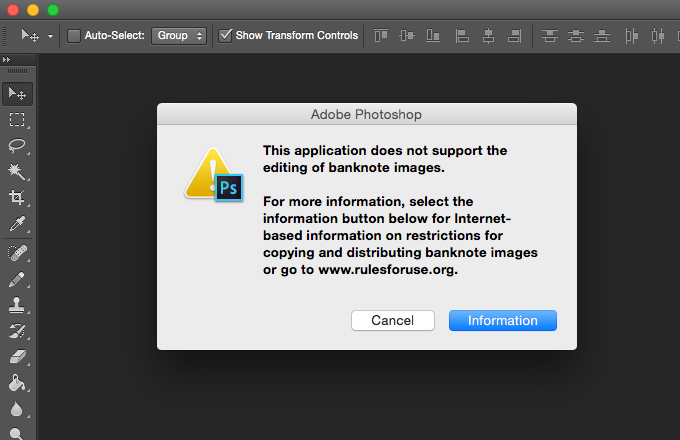
Let’s say you’re working on a design project and you want to work in some legal tender to give it that authentic look. If you do it with some lower denominations, no sweat: scan it up, take a picture or whatever, and edit away. With some denominations and currencies though, it’s not so easy. Photoshop will actually block you from opening the image.


What the what?


Now I get it. Adobe doesn’t want us using their software to counterfeit bills, which makes sense. (It’d create a ton of bad press if all of a sudden people were printing money like crazy all thanks to a Creative Cloud subscription.) But what if you had less nefarious plans? What if you just wanted to make some cool designs either onto the bank notes or using them in a pattern? Well, let’s figure out how to get around the baddies, shall we?


Step 1: Find an Image


After a quick Google search, I found a ton of scanned Canadian currency. A bunch of it has “Specimen” printed on the outside, but we want the legit stuff, so I pulled from the non-labelled models.


I started off with an older bill, and had no problems opening it up. So next, I tried the .


In an interesting twist, I could open up the original jpeg of the bill in Photoshop, no problem. But when I attempted to open up the screenshot to edit it for this post, it gave me the anti-coutnerfeit message. Weird.


I decided to take it to the next level and go with a 0 bill, which gave me the same message. Let’s check out the workaround.


Step 2: Start In Illustrator, Not Photoshop


First, I opened up the jpeg in Adobe Illustrator.


Next, I saved it as an Illustrator file. Then I opened up that file in Photoshop.


And, just like that, tada!


Tip: Don’t have Illustrator? No problem. All you need is an app that will open the image and is capable of saving it as a PDF. Preview for Mac is a good alternative.


Use Responsibly


Now remember, we’re not condoning the counterfeiting of money, because that’s highly illegal. That being said, there are legitimate use cases for using money imagery in design. As an example, just look at the header image for this article. We wanted to show a pile of money, but that photo was one that was blocked by Photoshop by default. Using this simple trick, we were able to get the effect that we wanted. Pretty handy!


Legal disclaimer: In many countries, there are specific laws governing editing of currency related images. Before you go fiddling with money too much in Photoshop, it’s a good idea to do your research to discover what is and isn’t allowed in your area.


Kevin Whipps is a writer and editor based in Phoenix, Arizona. When he’s not working on one of the many projects in his queue, he’s looking for fun and irreverent things online to share with his friends.

Products Seen In This Post:


Share on PinterestShare on Pinterest


getpaidtowrite-banner
Adobe Doesn’t Want You to Photoshop Money, Here’s How to Do It Anyway

Saturday, January 10, 2015

Free Pattern Generators: Here’s 8 Tools You Want To Bookmark

Patterns are widely used in web design as a background. Basically, patterns can be defined as graphics used in repeated form on a field. If you find yourself facing difficulties in creating natural patterns, that’s cause it is quite complicated to create a loop that works both vertically and horizontally, well, at least it’s difficult to do manually.


Fortunately there are many tools that you can use to make beautiful pattern easily and we are listing 8 of these that can be found online. Plus, they are free for use. Some of these pattern generators let you have control of colors, orientation, pattern elements and more, while others will randomly generate patterns for you. These patterns can then be downloaded in various image formats, or in code.


1. Patternify


Patternify lets you create patterns by drawing them pixel by pixel and is a good tool to create really small-sized icons. With the support of color and transparency options, you can make some cool graphics with this tool. In addition to the PNG format, this tool can also generate the image in Base64 format so that you can use it in your CSS.


2. Gerstnerizer


Gerstnerizer may give you colorless patterns but it makes up for it with patterns generated in lines. At the site, set the line thickness, opacity and the curvature of the line on the tool panel found on the left. Then you can choose from 3 pattern shapes: triangles, squares and hexagons. On the tile canvas underneath the pattern shape selection, draw lines and you will see a pattern emerge on the large canvas on the right. The pattern can be saved in SVG.


3. Tartanmaker


If you like criss-cross horizontal and vertical patterns, then Tartanmaker is the tool for you. Select 3 colors, the orientation, yarn size then click the ‘Make It’ button, and you will get a tartan pattern created for you. You can also scour the gallery for patterns made by other users and download it for free.


4. Stripe Generator


A simple tool to create great stripe patterns, you can add as many colors as you want to Stripe Generator then adjust the stripe size, spacing, background style, orientation and if you want to, add shadows. You can also browse generated stripe patterns by other users if you prefer to just look for a ready-made one.


5. Colour Lovers Seamless


Colour Lovers allows you to make patterns from predefined shapes and lines. Pick a line or drag a shape from the left panel and drop them onto the canvas area to start drawing your patterns. The tool will generate the tiles automatically. It comes with simple editing tools used to help you rotate, resize and rearange shapes on the canvas.


6. Patternizer


Patternizer is another pattern generator tool that makes it easy for you to get your own pattern. Pick a color, rotation angle, opacity, width, gap and offset to get your pattern. You can then grab the code for use on your site. Note that you will need to include a tiny script provided by Patternizer before you can use the pattern. Read the full tutorial here.


7. GeoPattern


GeoPattern provides a unique and random way to generate patterns automatically. You are only required to enter a text (any text) and the tool will generate a unique and beautiful pattern. Every character you type will produce a different image pattern based of the 16 awesome pattern types, like octogons, overlapping circles, plus signs, sine waves, hexagons, and more. Just try the demo to see how cool this tool is.


8. PlaidMaker


PlaidMaker is a tool to create a beautiful plaid pattern. Pick a color to use on the palette, then make the horizontal patterns and vertical patterns separately. You can also use mirror images on both orientations. If you don’t want to work from scratch, click ‘Browse Plaids’ to see ready-made designs and you can download it in PNG format for various mobile sizes and for Facebook cover sizes.


Free Pattern Generators: Here’s 8 Tools You Want To Bookmark

Free Pattern Generators: Here’s 8 Tools You Want To Bookmark

Patterns are widely used in web design as a background. Basically, patterns can be defined as graphics used in repeated form on a field. If you find yourself facing difficulties in creating natural patterns, that’s cause it is quite complicated to create a loop that works both vertically and horizontally, well, at least it’s difficult to do manually.


Fortunately there are many tools that you can use to make beautiful pattern easily and we are listing 8 of these that can be found online. Plus, they are free for use. Some of these pattern generators let you have control of colors, orientation, pattern elements and more, while others will randomly generate patterns for you. These patterns can then be downloaded in various image formats, or in code.


1. Patternify


Patternify lets you create patterns by drawing them pixel by pixel and is a good tool to create really small-sized icons. With the support of color and transparency options, you can make some cool graphics with this tool. In addition to the PNG format, this tool can also generate the image in Base64 format so that you can use it in your CSS.


2. Gerstnerizer


Gerstnerizer may give you colorless patterns but it makes up for it with patterns generated in lines. At the site, set the line thickness, opacity and the curvature of the line on the tool panel found on the left. Then you can choose from 3 pattern shapes: triangles, squares and hexagons. On the tile canvas underneath the pattern shape selection, draw lines and you will see a pattern emerge on the large canvas on the right. The pattern can be saved in SVG.


3. Tartanmaker


If you like criss-cross horizontal and vertical patterns, then Tartanmaker is the tool for you. Select 3 colors, the orientation, yarn size then click the ‘Make It’ button, and you will get a tartan pattern created for you. You can also scour the gallery for patterns made by other users and download it for free.


4. Stripe Generator


A simple tool to create great stripe patterns, you can add as many colors as you want to Stripe Generator then adjust the stripe size, spacing, background style, orientation and if you want to, add shadows. You can also browse generated stripe patterns by other users if you prefer to just look for a ready-made one.


5. Colour Lovers Seamless


Colour Lovers allows you to make patterns from predefined shapes and lines. Pick a line or drag a shape from the left panel and drop them onto the canvas area to start drawing your patterns. The tool will generate the tiles automatically. It comes with simple editing tools used to help you rotate, resize and rearange shapes on the canvas.


6. Patternizer


Patternizer is another pattern generator tool that makes it easy for you to get your own pattern. Pick a color, rotation angle, opacity, width, gap and offset to get your pattern. You can then grab the code for use on your site. Note that you will need to include a tiny script provided by Patternizer before you can use the pattern. Read the full tutorial here.


7. GeoPattern


GeoPattern provides a unique and random way to generate patterns automatically. You are only required to enter a text (any text) and the tool will generate a unique and beautiful pattern. Every character you type will produce a different image pattern based of the 16 awesome pattern types, like octogons, overlapping circles, plus signs, sine waves, hexagons, and more. Just try the demo to see how cool this tool is.


8. PlaidMaker


PlaidMaker is a tool to create a beautiful plaid pattern. Pick a color to use on the palette, then make the horizontal patterns and vertical patterns separately. You can also use mirror images on both orientations. If you don’t want to work from scratch, click ‘Browse Plaids’ to see ready-made designs and you can download it in PNG format for various mobile sizes and for Facebook cover sizes.


Free Pattern Generators: Here’s 8 Tools You Want To Bookmark