iPixel Creative is a Singapore web design and development Company. At iPixel Creative, we provides web design solution which helps your company stand out from the competitors. Our Solutions includes web design, website development, cms development, ecommerce solution and hosting solutions.
Do you find it difficult to find an excuse to take a break from your designing duties? If so, these fiendishly addictive design games are for you. Each one is ideal to play during your coffee break, no matter how short it is. And if any one asks, you can tell them that these games help hone your design instincts and sharpen your skills. Seriously.
In this post are 15 addictive games that test your knowledge on things related to design: fonts and kerning, colors and hues, hex codes, site layouts and more. Race against the time and compare scores with your fellow designers, and most of all, have some fun.
Think you know magenta from fuchsia or snow from ivory? Here’s a chance to test your eye for subtle shade differences as you race against the clock to identify the correct design color in this great game from Kolor.
Laying out text evenly on the page, or ‘kerning’ as it’s known in the typography business, is harder than it looks. However, as any self-respecting designer will tell you, it’s integral to creating slick content on the page.
There’s a fine art to shaping letters, especially when you want to create an aesthetically pleasing image on the screen. Test your skills with this fun, tablet-compatible game. IT’s harder than it looks.
Whoever said that hex codes were fairly useless in terms of everyday skills obviously never played this game! It’s based on the classic arcade game, but with a cunning design twist, of course. To destroy the invaders, you’ll need to match the supplied hex code that appears on the top of the screen.
Ever struggled to draw things in your designs with the pen tool? With Bezier, you get a tutorial that shows you how to use the pen tool to draw several shapes. Just copy the steps to quickly master the pen tool. Replay the tutorial if you find yourself at a loss.
Are you an RGB code master, or do you struggle to get your head around remembering them? If you think you’re a bit of a color expert, here’s the game to test your skills to the max. Make no mistakes, because any mistake sends you back to the beginning. See if you can beat your best score!
Brandseen gives you the chance to combine your knowledge of some of the world’s most famous brands with your color identification prowess. You’ll be shown 9 of the most iconic logos, and you’ll need to use your supreme design-jedi master skills to match the right color to the logo design.
Now it’s time to get serious about testing your color knowledge. This simple, yet comprehensive test challenges your eye in finding the right shade. You’ll need to identify complementary colors, analogous hues, triadic, tetradic and saturation.Or just try to get the color in the middle circle right. Good luck!
Here’s a nice color recognition game with a twist. You’ll need to find the odd one out each time, but be warned, the game gets progressively trickier! It’s a great way to train your eyes to get used to subtle differences between hues, which is always useful when designing a site.
If you think you’re good at picking up subtle color differences, then this game tests how effective you are at identifying the lighter color, against a ticking clock. You’ll need to have lightning reflexes and quick fingers to score well, and it’s a good game to compete with friends.
Pixactly is the game that assesses how well you really know your pixels. All you’ve got to do is draw a box that matches the width and height dimensions given, and see how close you get to the right answer. Sounds easy, right? There’s only one way to find out.
According to the statistics included on this site, 1 in 255 women and 1 in 12 men have some sort of color vision deficiency. No matter your gender, we suspect you’ll find this color sorting game quite challenging!
As designers, we use fonts all the time. So why are the names so hard to remember? If you’re constantly finding that the name of the perfect font that is just at the tip of your tongue, here’s a game to help improve your knowledge and understand the subtle differences between font styles.
It’s amazing how instantly recognizable some websites are, just from their layout. This fascinating quiz proves the point perfectly, though you’ll also be amazed at how many you recognize, but aren’t quite sure which site they are!
Select your level of design skill, then shoot only the serif fonts in order to get promoted. It’s an addictive shoot-em-down style game that helps you easily identify serif fonts. Just make sure you leave the sans serif standing!
We hope you enjoyed your break, had a lot of fun, and even learned something new! What’s your favorite game? Do you know any other great design quizzes, tricky experiments, or challenging apps? Do share your scores, achievements, and thoughts!
Editor’s note: This is written by Lana Lozovaya for Hongkiat.com Lana is the content strategist and social media manager at PSD2HTML®, the leading PSD to HTML and web development company.
Do you find it difficult to find an excuse to take a break from your designing duties? If so, these fiendishly addictive design games are for you. Each one is ideal to play during your coffee break, no matter how short it is. And if any one asks, you can tell them that these games help hone your design instincts and sharpen your skills. Seriously.
In this post are 15 addictive games that test your knowledge on things related to design: fonts and kerning, colors and hues, hex codes, site layouts and more. Race against the time and compare scores with your fellow designers, and most of all, have some fun.
Think you know magenta from fuchsia or snow from ivory? Here’s a chance to test your eye for subtle shade differences as you race against the clock to identify the correct design color in this great game from Kolor.
Laying out text evenly on the page, or ‘kerning’ as it’s known in the typography business, is harder than it looks. However, as any self-respecting designer will tell you, it’s integral to creating slick content on the page.
There’s a fine art to shaping letters, especially when you want to create an aesthetically pleasing image on the screen. Test your skills with this fun, tablet-compatible game. IT’s harder than it looks.
Whoever said that hex codes were fairly useless in terms of everyday skills obviously never played this game! It’s based on the classic arcade game, but with a cunning design twist, of course. To destroy the invaders, you’ll need to match the supplied hex code that appears on the top of the screen.
Ever struggled to draw things in your designs with the pen tool? With Bezier, you get a tutorial that shows you how to use the pen tool to draw several shapes. Just copy the steps to quickly master the pen tool. Replay the tutorial if you find yourself at a loss.
Are you an RGB code master, or do you struggle to get your head around remembering them? If you think you’re a bit of a color expert, here’s the game to test your skills to the max. Make no mistakes, because any mistake sends you back to the beginning. See if you can beat your best score!
Brandseen gives you the chance to combine your knowledge of some of the world’s most famous brands with your color identification prowess. You’ll be shown 9 of the most iconic logos, and you’ll need to use your supreme design-jedi master skills to match the right color to the logo design.
Now it’s time to get serious about testing your color knowledge. This simple, yet comprehensive test challenges your eye in finding the right shade. You’ll need to identify complementary colors, analogous hues, triadic, tetradic and saturation.Or just try to get the color in the middle circle right. Good luck!
Here’s a nice color recognition game with a twist. You’ll need to find the odd one out each time, but be warned, the game gets progressively trickier! It’s a great way to train your eyes to get used to subtle differences between hues, which is always useful when designing a site.
If you think you’re good at picking up subtle color differences, then this game tests how effective you are at identifying the lighter color, against a ticking clock. You’ll need to have lightning reflexes and quick fingers to score well, and it’s a good game to compete with friends.
Pixactly is the game that assesses how well you really know your pixels. All you’ve got to do is draw a box that matches the width and height dimensions given, and see how close you get to the right answer. Sounds easy, right? There’s only one way to find out.
According to the statistics included on this site, 1 in 255 women and 1 in 12 men have some sort of color vision deficiency. No matter your gender, we suspect you’ll find this color sorting game quite challenging!
As designers, we use fonts all the time. So why are the names so hard to remember? If you’re constantly finding that the name of the perfect font that is just at the tip of your tongue, here’s a game to help improve your knowledge and understand the subtle differences between font styles.
It’s amazing how instantly recognizable some websites are, just from their layout. This fascinating quiz proves the point perfectly, though you’ll also be amazed at how many you recognize, but aren’t quite sure which site they are!
Select your level of design skill, then shoot only the serif fonts in order to get promoted. It’s an addictive shoot-em-down style game that helps you easily identify serif fonts. Just make sure you leave the sans serif standing!
We hope you enjoyed your break, had a lot of fun, and even learned something new! What’s your favorite game? Do you know any other great design quizzes, tricky experiments, or challenging apps? Do share your scores, achievements, and thoughts!
Editor’s note: This is written by Lana Lozovaya for Hongkiat.com Lana is the content strategist and social media manager at PSD2HTML®, the leading PSD to HTML and web development company.
A good design school will absolutely get you on the right track to becoming a talented, qualified professional. However, it’s simply not in the cards for everyone. Fortunately, you can still fulfill your dream of becoming a designer without a formal education, as long as you have the drive and dedication to pull it off.
Design School: Important or Not?
As far as the design industry is concerned, the debate rages on. You can’t really blame people for thinking that design school is not really as important as the industry makes it out to be. After all, the most important aspect of creating fantastic design is creativity, something that people are born with and develop through time, and not something you learn from textbooks and modules.
But then again, your creativity alone will not really get you anywhere if you don’t know the basics of design. No matter how unique your concepts are, you would also have to present them in the most professional way possible, especially if you want to make a serious career out of it. This is where the value of proper design education comes in. It teaches you the basics and the ins and outs of every possible tool and theory that you will need to progress in the specific niche you want to concentrate on.
Design School Drawbacks
The drawback to design school? It’s pretty simple. Not only does it cost a fortune to go to design school, it also takes up at least four years of your life. This is something that is just not possible for many people, especially if they don’t have the financial capacity. A lot of kids have to start working the moment they reach legal age, so how can they keep their heads above water in the short term without having to sacrifice their long-term dream?
Meet Karen X. Cheng
People who frequent YouTube will probably remember Karen Cheng as the girl who taught herself how to dance in just 365 days. The video she made out of the entire experience was truly inspiring, causing it to go viral online.
But for those in the field of design, Karen Cheng is the former Lead Designer at Exec. And yes, she never went to design school. In a recent Quora post, she shared her story.
“I didn’t have four years and 0,000 to go to design school,” she says. Did this stop her from becoming a designer? No, it didn’t. And to add an even bigger load of surprises, she admits that she has no discipline.
“People thought I have discipline because I was able to teach myself how to dance in just 365 days,” she states in an interview, “The truth is, I don’t have discipline. It’s just that I loved dance, I just did what I love.”
This is exactly what Karen advises to people who want to do the same groundbreaking accomplishments that she had. Do what you love.
She had been working on Microsoft Excel for two years when she realized that this was not what she wanted to do for the rest of her life. She knew that she was meant to do something else. This is what made her think about moving into a different industry. This is what got her started in the field of design.
“I had no design-related skills. I did not want to go back to school.”
For Karen though, that was not a problem at all. She would breeze through her day job and rush home, and devour material that allowed her to learn more about the basics of design. She put together her own curriculum, covering everything that she felt she needed to learn in a span of six months.
Just like that, she plunged into the job market, now as a designer. Of course, it wasn’t easy. She did not have as much training as the other people who were eyeing the same positions she wanted, and she definitely did not have relevant experience. But she didn’t give up. She decided to find ways to set herself apart from everybody else. That’s how she got the job as a designer at Exec, and from there, went on to lead the entire design team.
Inspired by Karen Cheng’s story? Well, you know that if Karen did it, then you also can. You just need to get started and start grabbing opportunities that not a lot of people would take.
Here are a few steps that could help you get started and inch closer to your dream:
Building Your Foundation
At first, Karen was probably not as good as those people who went through four years of design education. But she still did her job well enough to take her places in the industry. She just had to learn how to start.
Her biggest mistake? Jumping straight into Photoshop. Just because you buy a paint brush does not mean that you’re already an artist. You have to start with the basics. And for a career in design, you have to start from scratch.
Learn how to draw first. You don’t even have to enroll in an art class. Karen recommends the book You Can Draw in 30 Days. Allot at least 30 minutes of every day for a month just trying to draw. Once you’ve learned the basics and have given your hands used to the daily workout, move on to the next step.
Learn graphic design theory. The book Picture This is what Karen recommends when you get to this step. It gives you the basics of typography, color, and designing with a grid.
Text also plays a huge role in design, so you should also learn how to write. You’ll see mockups using the standard Lorem Ipsum text, but you have to be creative in every aspect. Get a feel for words. Give the audience the entire package by showing them the emotions they’re supposed to fell not just through the graphics, but through the words you use as well. Try visiting the website Voice and Tone, it should give you great tips on how to talk to your audience.
Lastly, learn how to slaughter your work. This is one basic reality about design that a lot of rookies fail to get. When one design does not work, get rid of it and start anew. Don’t waste your creative juices by trying to improve something that’s not all that. Just let go of it and create something fresh and completely different.
These should pretty much sum up the foundation-building part of your training. Now that you’re equipped with the basics, it’s time to move on to more complicated things.
Mastering the Software
You don’t think you could escape those computer programs, could you? Even if you want to go old school and would like to create things by hand, you can never deny the fact that the entire world has gone digital. Therefore, you also have to be prepared to create work digitally.
Adobe Illustrator. Yes, it’s still not time to learn Photoshop yet. Better start with Illustrator first. You’ll find so many video tutorials online, and you can also try out a few textbooks. Adobe Illustrator Classroom in a Book has all the basics, and going through the first half of it could give you pretty much everything that you need to know.
Adobe Photoshop. Finally, it’s time for you to learn how to Photoshop. Again, you can find so many tutorials online, but make sure you choose only the best. Try to find stuff from PSDTuts and TutsPlus. They have great tips that are easy to understand and could really help you master the craft of Photoshopping.
There are so many other design programs out there, but these are two of the most popular. You can try to learn the other programs one by one as the need arises. For instance, if you’re going to do any print design, you’ll definitely need to learn Adobe InDesign.
Finding Your Specialty
As a design guru, you have to figure out what you want to specialize in. You don’t want to be the jack-of-all-trades when it comes to design, you want to be the master of a specific niche. You have to choose one area for you to focus on so that you could have a clearer path set out for you, especially when it comes to figuring out the next few steps that you’re going to take.
Logo Design. Interested in building logos for a brand? This is a great choice. If you think that all there is to logo design is the logo itself, you are greatly mistaken. Most of the time, a designer is signed on board to create not just a logo, but an entire brand identity. This means that you would also have to imagine that logo on a wall, on an office door, on a piece of stationery, and everything else that comes with it.
Hand Lettering. If you enjoy hand lettering there is alot of demand for it right now. People are in love with hand crafted and personalized designs. Why? Because it brings a human element to design. In today’s digital world brands are seeking a hand-made aesthetic. You can find great hand lettering courses on Skillshare.com, Seanwes.com, Youtube.com, and Lynda.com.
Mobile App Design. Mobile apps are obviously very much in demand, but you also have to be ready for a lot of competition. Tapworthy is one book that you may want to go through should you want to concentrate on this niche.
Web Design. Obviously, this is one of the popular choices when it comes to specialization. Try reading The Principles of Beautiful Web Design as it has all the basics you need. Feel free to jump from one website to another as well, taking note of the design aspects that you like the most about each website you see.
From here, it’s so easy to start building your own portfolio. Start out with a few concepts and then bring them to life. Find friends who may be needing your services, and try to pitch some of your ideas. Mind you, the first few attempts at trying to get your first clients would be challenging. But once you make the first one happy, everything else will just fall into place.
Start Your New Career Right Now
Before I let you go, I would like for you to take a look at these important bullet points. Everybody loves bullet points, right?
Always Be Creating. Experience is very important. Nobody will want to hire you without it. Use your free time to create, learn, and educate yourself. Find tutorials, try different side projects, and focus on creating a large quantity of work.
Be Exceptional. Do something that separates you from the crowd. Find a niche or come up with a unique idea that will make you a hot commodity. A good example of this is Sean McCabe. During his free time he really enjoyed hand lettering. He started posting his work on Dribbble, Twitter, and Instagram. People took notice and now he is known as the hand lettering guy among the design community. Even though there are hundreds, if not thousands, of talented hand lettering artists out there, he comes to mind first.
Learn the business of design. If you’re planning on taking the freelance route, you should learn some basic business principles. You should focus on learning client negotiation skills, how to create a proposal or design brief, how to price your work, how to write a contract, how to track your time, and how to invoice your client in a professional manner.
If you’re a designer and you want to pull in some work, how do you stand out from the crowd? Easy. Make an animated video like Marta Berzina did, and then break them down into cute animated GIFs.
Now we know this would probably take a decent amount of time to do, and sure, not everyone has the ability to do this type of thing. But it sure does work, because if we noticed it, we’re sure other people have, too.
When I first met my wife, I was a media buyer working in the depths of Excel sheets and marketing budgets. Her department was viewed (by me and others in media) as another world. Their room was dimly lit; there were odd toys scattered about the room; and they laughed at fonts. Oh, and everyone had large computers. I envied those computers.
My office was shared with another media buyer and was located next to the copy room—a location I now believe was given in hopes the copy machine would drown out my talking and bouts of singing. For months, one of the designers would frequent the copy room and then pop her head into our office to chat about YouTube fails and concerts. I thought she had a crush on the other buyer. It took me a while to realize she had nothing to copy, and she liked me. When I realized this, I started staying late in order to work on “projections” and “flighting” in the hopes of walking out together. Sweet potato cake, flowers, secret dinners, and a flat tire later, we finally started dating.
Now married and a designer myself, I can never thank my wife enough for helping me cross the great divide between media and creative. It’s a better world on the other side. And if you don’t believe me, here are the top 10 reasons why marrying a designer was the best thing I did.
Infographic
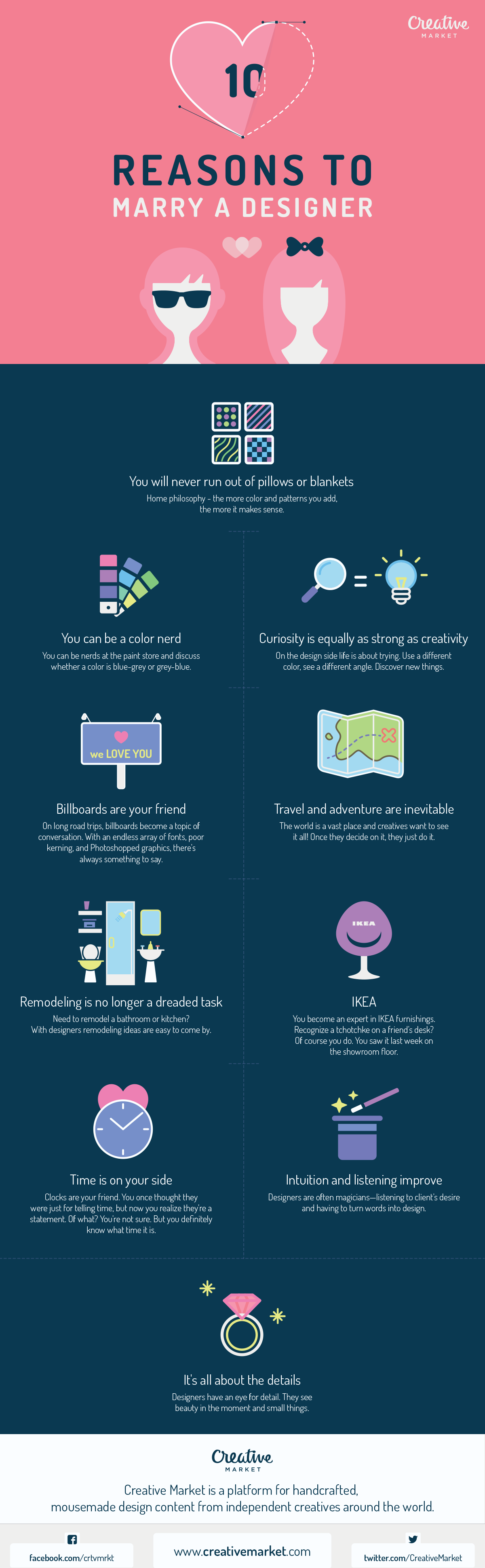
Top 10 Reasons to Marry a Designer
1. You will never run out of pillows or blankets
Our (white) couch seems to have an endless supply of patterned accessories. We have a philosophy in our home, the more color and patterns you add, the more it makes sense.
2. You can be a color nerd
You can be nerds at the paint store and discuss whether a color is blue-grey or grey-blue. My wife often asks me if I’m colorblind. Which doesn’t really bother me as I feel her staunch defense of “grey” is reason for me to suspect she herself is colorblind. We’ve reached a draw on this point. (P.S.—I apparently think everything is blue.)
3. Curiosity is equally as strong as creativity
Squid? Sure. Travel detour? Why not. Life on the media side was about prediction and analysis. On the design side, however, life is about trying. Use a different color, see a different angle. Ask a friend. Whether music, food, or random facts, my wife loves to discover new things. (see #5)
4. Billboards are your friend
On long road trips, billboards become a topic of conversation. What are we looking for? Simplicity and legibility. With an endless array of fonts, poor kerning, and Photoshopped graphics, there’s always something to say. And hey, it’s not all bad. Sometimes we simply say, “Oh, I like that!”
5. Travel and adventure are inevitable
The world is a vast place and creatives want to see it all! Paris had always been on my bucket list, and in our first year of marriage, my wife simply said, “So…why don’t we just go?” We did. For her birthday last year, we went dogsledding. February can be a doldrum of a month. But snow and huskies? That’s a winning combination. Best. Birthday. Ever.
6. Remodeling is no longer a dreaded task
Need to remodel a bathroom or kitchen? Remodeling ideas are easy to come by. Sure, you can get stuck in the cycle of point #2, but that just means you’ll be happier with the color once you finally agree. Now actually doing the work… well, that’s a different topic.
7. IKEA
You become an expert in IKEA furnishings. Recognize a tchotchke on a friend’s desk? Of course you do. You saw it last week on the showroom floor. Which also happens to be where you picked up that cool font poster.
8. Time is on your side
Clocks are your friend. You once thought they were just for telling time, but now you realize they’re a statement. Of what? You’re not sure. But you definitely know what time it is. Everywhere. And yes, they too, came from IKEA.
9. Intuition and listening improve
Designers are often magicians—listening to client’s desire and having to turn words into design. You become a master at the phrase: “So what you’re actually saying is…” BONUS: This skill works both with clients as well as at home with each other on pizza night.
10. It’s all about the details
Designers have an eye for detail. Whenever we’re about to buy something, my wife will do “QC” (quality control). When giving clothes as a gift, she’ll go into hawk-eye mode and make sure there’s not a sewing anomaly or dangling thread. More than threads, though, she sees beauty in the moment. I’m often apt to miss a photo opp even when it’s right in front of me. During a mountain drive, I had numerous photos of the endless views, but she stopped me to snap a picture of this roadside flower (below). It’s one of her favorite pics.
Designer and Spouse
My wife continues to challenge my perspectives on design and life. And while I’m often amazed at her InDesign wizardry, I’m more grateful that she’s an encourager—compelling me to see more, do more, try again, see people in a new light and simply be myself. She likes my singing. And let’s be real—I definitely use those blankets while on the couch.
What About You?
Do you have a spouse or friend that’s a designer? What are some of their quirks that you love?
Stephen Palacino is the owner of Page1 Branding, a web design and brand development company in Greenville, South Carolina. Working primarily with startups and small businesses, he enjoys helping clients define their story alongside their passion. You can read more from Stephen on branding and life at his blog. 10 Reasons Marrying a Designer Was the Best Thing I Ever Did