iPixel Creative is a Singapore web design and development Company. At iPixel Creative, we provides web design solution which helps your company stand out from the competitors. Our Solutions includes web design, website development, cms development, ecommerce solution and hosting solutions.
To add to that pile, we have here an infographic by Modis which is trying to make a case for a tech-free vacation, the kind that can really help you recharge properly. Apart from that, it also carries a few tips you should follow should you take heed and decide to take a break from it all, for instance, letting people know you are going to be unreachable during your vacation period, before you take off.
And best of all, it mentions a few vacation spots (where it is is geographically impossible to stay connected to the Web) which can give you the silence and relaxation your body has been craving for, and so sorely deserve.
FilterGrade is back again this week with another premium design resource for Access All Areas members. There’s already 3 collections of FilterGrade Actions available for members; the Vintage Batch Filters and two complete packs from the Light Leaks Series, but today members are also being treated to the brand new FilmTone product. These high quality Photoshop Actions generate natural film looks and filters to instantly give your photos the nostalgic feeling of analog photography.
The FilterGrade Shop is stocked full of Actions of various types, including fashion styles, photo retouching tools and plenty of cool effects. Check out the Best Sellers list to see the most popular products, including the Quick Tone and ColorWash Actions to further enhance your photos with retro styles, or the 220 Photo Action Bundle for a selection of all 11 FilterGrade series in one pack.
FilmTone is a brand new product from FilterGrade and the latest resource for Access All Areas members to download as part of their membership. It’s a collection of 25 professional Photoshop Actions that apply a variety of subtle analog film effects to your images. Check out the before and after previews to see how the faded pastel colours and realistic grain add the finishing touches to your photos.
You’re probably thinking of your own version of the “perfect” design. Whatever it is, you probably have fond, nostalgic feelings around it, and would likely defend its rightful place among the best in the world.
The thing is, there are probably some people who share your opinion, but many more who don’t. This is perfectly okay, because it means that you as a designer have even more opportunities to reach your own special niche audience.
Don’t Think Of Everyone
You don’t have to try to make that “perfect design” that will appeal to everyone. I can’t even imagine what that would look like, but it likely would be terrible. Why? Because people have such different expectations that trying to fulfill them all is always going to fail miserably.
This is why generic designs never sell as well as many clients seem to think they will. The next time your client insists that you try to reach a more “general” audience with your design, remind them that no one wants to bother with something that’s made with “everyone” in mind.
Image Source: via Shutterstock.
Think about it: what else is made for “everyone”? Let’s see… car dealerships (with a thousand different choices and options), hospitals and health care facilities (with multiple specialists to cater to virtually anyone’s particular problem), newspapers (with hundreds of sections for people to flip right to the information that interests them). Do you see a pattern here? Even things that are supposedly for everyone have many, many subcategories, so that “everyone” can filter themselves into more easily manageable groups.
What You Want Vs. What Is Best
You have to line up your message with the needs of your niche audience. If this happens to include your own needs, then it will be easier for you to engage personally with whatever it is you’re selling.
There’s a lot to be said for being able to stomach the work you must do as a designer. If you hate the message you’re sending out, perhaps you need to question whether or not you need to find new clients. The relationship between designer and client should be symbiotic, and also sync up with whatever it is your client’s target market is looking for.
Which Version Is The “Right” One?
There is never one perfect solution to a design problem that will satisfy absolutely everyone. There are only a series of perfect solutions, each one tailor made to fit a very specific group of people – sometimes extremely specific.
Malcolm Gladwell famously outlined this tendency of ours to prefer a multitude of different solutions in his legendary TED talk about spaghetti sauce. He gave examples of the spaghetti sauce manufacturer, Prego, that stumbled upon a completely untapped market when it began offering “chunky” spaghetti sauce, in addition to the thinner, more traditional Italian-style sauces.
To use an even more specific example of multiple solutions to problems, most cat owners are perfectly happy training their cat to use the litter box. Some owners, on the other hand, choose to take things a step further, and actually hire someone to train their cat to use the toilet. That’s right. There are cats who are actually potty trained.
Quite literally, there is a product or service out there that caters to every possible need.
In Conclusion
Don’t confuse your personal favorite designs with the one your target audience is hungry for. Make sure you choose a market that you understand and you can satisfy without selling your soul. Figure out that unique, perfect solution to your clients’ needs, and the needs of their customers, and everything will be just “perfect” from there.
Design services: every business needs them, but some can’t afford them— or at least, some believe they can’t afford them. For those penny pinchers out there, we’ve collected some money saving tips that will cut down your design spending so you too can have an amazing web and print presence.
1. You don’t always need a complete redesign
Starting from scratch is a good feeling, but it doesn’t always fit the budget or your best interests. There is almost always room to work and improve on something that is already built. With time, cautiously reshaping work will help refine it. You often see large brands like Google and Instagram making small tweaks to their logos instead of going for a complete redesign. Beware the designer who urges you to start over, even if it is with the best of intentions. Remain in control of the vision and weigh the costs of starting from zero.
2. Hire someone who has already done similar work
Think about it this way: there’s a reason Jackson Pollock never succeeded in interior design. Pick the right artist for the right job. Look through a designer’s portfolio and try to imagine what their finished product might look like. If you can’t picture it or it doesn’t match your expectations, don’t bother. You’ll save countless revisions and changes in the future as you try to work your way into each other’s minds.
3. Supplying the theme or template will save you money
Yes, everyone wants a completely unique design, but be realistic. Are your customers or clients really going to critique you if there are minor structural notes, fonts, or colors that they’ve seen before? Probably not. Save some time, money, and stress by getting a template from an online marketplace like Creative Market.
Pre-made design pieces are cheap and incredibly useful when properly used. Aside from saving you (and your designer) precious hours, templates can also help convey your vision for the project.
4. It’s okay to shop around
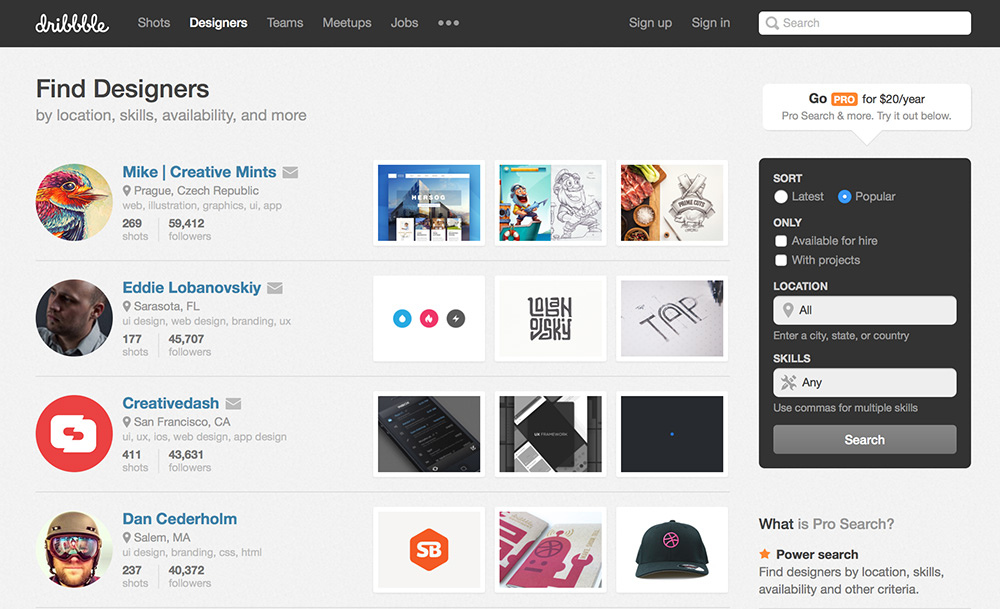
The savvy seeker will carefully examine all options before making a decision. However, this doesn’t mean having ten designers do a full mock up before you make the call. Use careful discretion while looking through a pool of choices, but narrow it down to just a few before asking for any sort of mock up or “audition.” Another pro tip: always shop. Stay updated on online graphic portfolio sites like Behance or Dribbble. You can make a shortlist of designers that catch your attention for ease when it comes down to hiring.
Pro tip: There’s a special section on Dribbble where you can find designers that are up for hire.
5. Use a service
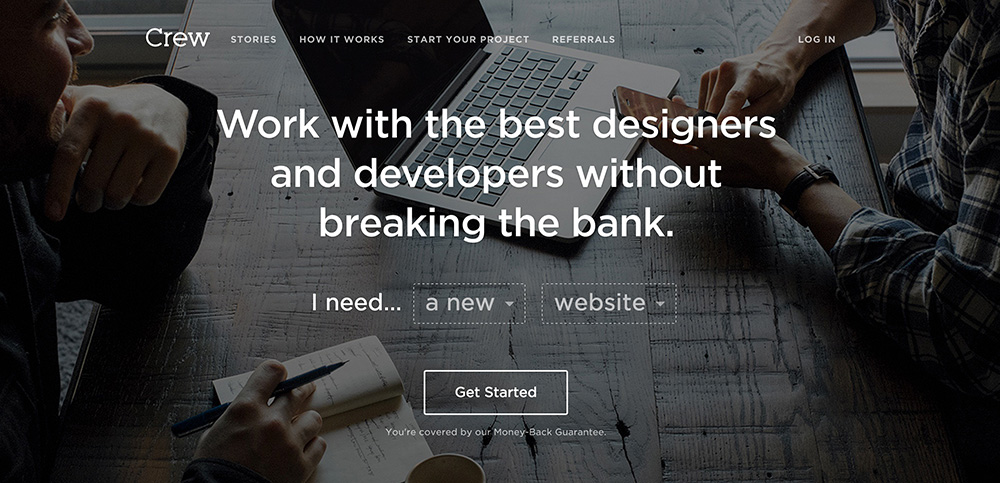
If you’re having trouble finding someone that you can trust with your vision, try a service like Crew. You simply describe the project you need help creating, and Crew will match you with skilled and affordable designers. They will also help you through each part of the process even the tough steps like payments and contracts
If you follow these five tips and keep a careful eye on your budget, you’ll be able to get the design you need without spending the money you need for everything else. The most essential piece of advice when going through all of this is to be patient and research as much as possible. There are dozens of ways to get things done on the cheap.
You know how things go in the marketing department of the big companies nowadays. They want to be “hip” and speak the language of the younger generation. They’re totally down with their lingo, you dig? They get it.
Sigh.
To promote the 2016 Cruze, Chevrolet released a hashtag on Twitter — #ChevyGoesEmoji — and with it, an all-emoji press release to, you know, “go viral.” (And if we’re talking about it, I suppose that means they were successful.) The thing is, they didn’t translate the thing for a good portion of the 22nd, and by the time people were talking about it on the 23rd, it was already translated by comedian Norm Macdonald. No, seriously.
So with that, we give you Chevy’s latest ploy to get you to buy a car, and the translation by a man who was marginally funny in the ’90s, when many millenials were born. Enjoy.
Shorthand and Longhand – one is concise and the other precise. One came to existence out of the want for brevity, while the other stands firm to preserve clarity. Either way, they have their purposes, pros and cons, so to speak.
This post will shine some light on both CSS shorthand notations and longhand notations, while concluding which is best to use for which situation.
What is Shorthand Property?
Shorthand property is a property that takes the values for other sets of CSS properties. For example, we can assign a value for border-width, border-style and border-color using the border property alone.
With this, we don’t have to declare individual property values separately (which is redundant, time- and space-consuming). It also resets the left-out properties in the declaration, something which can be taken advantage of.
How does it work?
Like previously mentioned, we write a set of other property values in shorthand, the order doesn’t matter if all the property values in the shorthand are of a different kind like in border. For properties with similar kinds of values like margin, order does matter. When in doubt, remember clockwise!
Now, what if we miss a property or two in the declaration? In the above example, let’s say we ignored border-style.
border: 1px blue;
We won"t be able to see the borders anymore, not because the shorthand property didn"t work but because the border-style which we left out, got the default value none. This is how that shorthand property got rendered.
border: 1px none blue;
Now let’s drop the 1px for border-width and keep the other two:
border: solid blue;
We"ll be able to see the borders, only with a thicker width and that"s because the border-width property got the default value medium.
border: medium solid blue;
This concludes it for us that when a property value is left out in a shorthand declaration, that property takes on its default value (even if it has to override any previous value assigned for the same).
If there is border-width: 1px; for an element somewhere before border: solid blue; for the same, the border width is going to be medium (the default value), not 1px.
Another thing worth mentioning is that we cannot use values like inherit, initialorunset, which are available for all the CSS properties, in shorthand notation. If we use those, the browser won"t be able to know exactly which property that value is supposed to represent in the shorthand – the entire declaration will be dropped.
The all property
There is one CSS shorthand property that can set the value for all CSS properties. CSS-wide values inherit, initial and unset are applicable to all of the properties and hence these are the only values accepted by the all property.
div
 all: initial
This will make the div element ditch ALL of the CSS property values it had, and reset the default value in each of them.
⚠ Warning
Let’s not misuse the all property. The need for it may arise only in very rare circumstances, when we are not able to touch any previous CSS code of an element that we wish to apply this property to.
Note: CSS property color takes hexadecimal value with shorthand notation if the two numbers of hex value in every color channel is the same. For example, background: #445599; is same as background: #459;.
What is longhand property?
The individual properties that can be included in a shorthand property are called longhand properties. Some examples are; background-image, margin-left, animation-duration, etc.
Why should we use it?
Even though shorthand alternatives are handy, they do have a disadvantage. Remember in the beginning we saw how shorthand overrides any left out properties with their default values? This can be a problem if the reset isn’t desired.
Take the font shorthand property for example. Let’s use it in the h4 element (which has a default browser style font-weight:bold)
font: 20px "courier new";
In the above shorthand code, no value is there for the font-weight property, hence the font-weight:bold(browser default style) will be overridden by the default value font-weight:normal causing the h4 element to lose its bold style, which may not has been intended.
So, for the above example simple two longhand properties, font-size and font-family are perfect.
Also, using shorthand for assigning only one or two property values is not very useful. Why give the browser extra work to interpret every single property (including the left out ones) in the shorthand, when only one is needed to work?
Production aside, during development stage, some developers (especially beginners) may find using longhand notation a lot easier to work with than shorthand for better readability and clarity.
Conclusion
Nowadays with the possibility of fast coding (with the help of tools like Emmet) and minification, a high reliability on shorthand is not needed, but at the same time, it is a lot logical to type margin:0;. The context in which we prefer our CSS notations will vary and all we have to do is figure out what notation will works best for us and when.
Every website designer or website owner need hosting for their projects. Today we have partnered up with Eleven2. They are offering all Creative Overflow visitors 60% off all web hosting and reseller hosting.
The 60% discount applies on any billing term! Therefore you determine how much you’re saving in the long run.
Who is Eleven2?
Eleven2 has been hosting websites since 2003! They know what works and what doesn’t. If you want a fast website with a stable network and superior support, then look no further! Eleven2 has some great packages to get you going that won’t break the bank.
Coupon code: creativeoverflow
Need more power? VPS are also on sale!
You can take 60% off the first month on any Eleven2 managed VPS. That’s right. 60% off the first month!
Coupon code: creativeoverflowvps
Make sure you get in on this massive saving for your next host selection. That’s literally all we have for you today. There are no other catches, just the massive discounts above.